 Most paste backfill disasters do not begin underground. They begin in a conference room, right after someone says, “The quote looks good.” A paste backfill system is not a pump skid with a mixer attached. It is a production promise. It touches your stope cycle, your tailings management, your water balance, your ventilation, your labor, and your closure liability. If you buy it like a commodity, you will operate it like a problem.
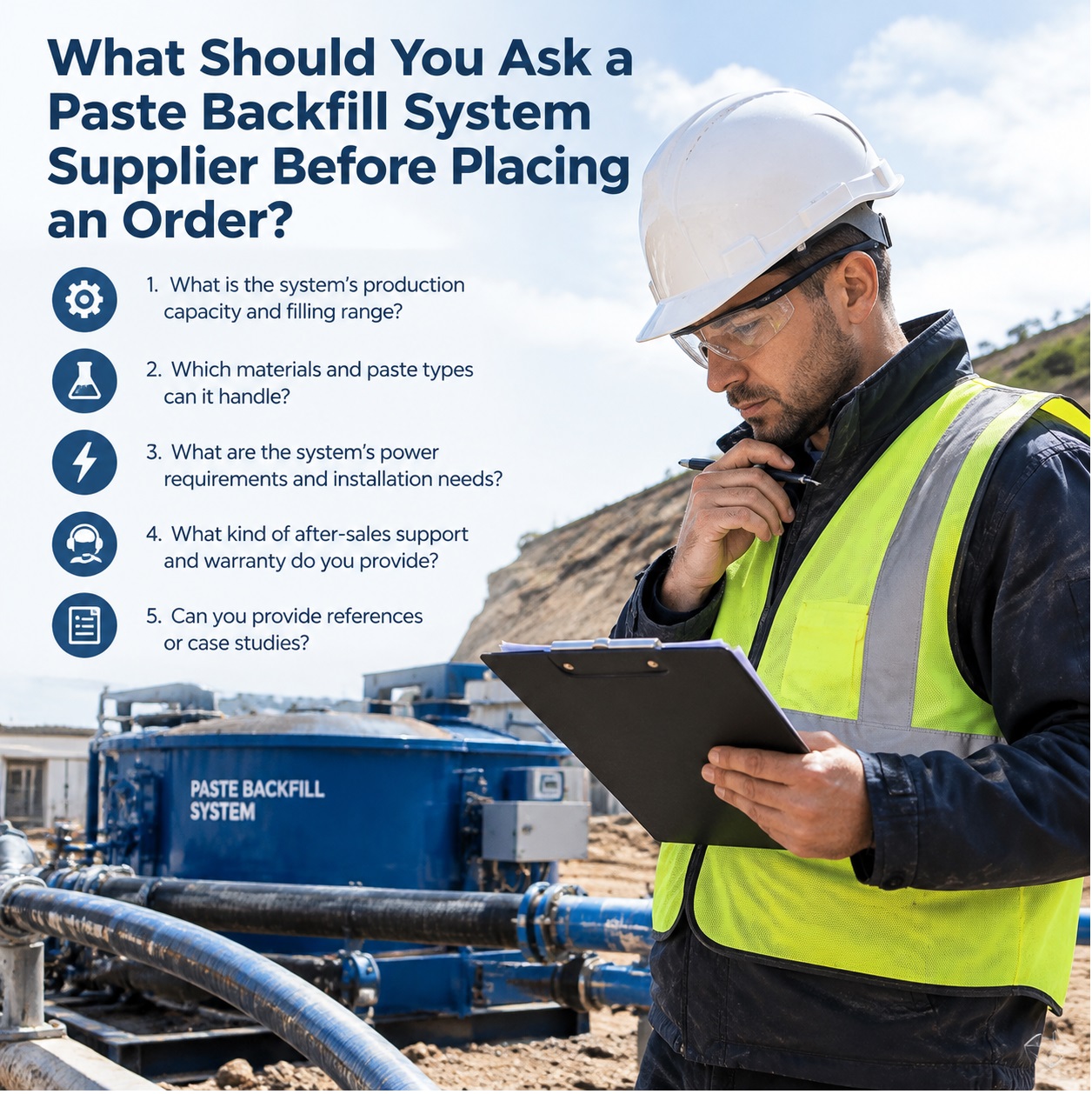
Before you place an order, make the supplier earn the purchase order with answers, not adjectives. Here are the questions that separate a real backfill partner from a vendor with a shiny brochure.
Start with your tailings, not their catalog. Ask what assumptions they made about your tailings. Particle size distribution, specific gravity, sulphide content, clay fraction, water chemistry, and how those change from one month to the next. If they used a generic sample or a “typical” database, stop. Paste is not typical. Your orebody is not typical. A supplier who has not tested your material is guessing, and you will pay for that guess in every blocked pipe and weak fill mass.
Ask for the mix design logic. What binder are they proposing, at what dosage, and why? What strength curve are they targeting, and at what age? How does the recipe change when your tailings thicken differently in rainy season or when the mine plan shifts to a new zone? A good supplier will talk about rheology, yield stress, slump, and pipe loop tests. A weak one will say “we have done this before” and hope you do not ask for numbers.
Then ask how they will prove the strength underground. Lab cubes are a start, but stopes do not cure in a lab. Ask about field sampling, cure monitoring, QA/QC protocols, and what happens when a test result misses the target. Who pays for remediation? Who investigates? Who signs off? If the answer is vague, the risk is yours.
Ask about availability, not just capacity. Every supplier claims high throughput. The real question is how many hours per day the plant actually runs. Ask for component redundancy, maintenance access, mean time to repair, and critical spare parts. Ask what happens when the mixer wears, the pump fails, or the control system loses a sensor. Ask how long it takes to flush the line and restart after a power dip. These details decide whether backfill supports your cycle or becomes the reason your cycle slips.
Ask for the total cost per cubic meter. Equipment price is only the entry fee. Binder consumption, energy, water, wear parts, labor, and downtime are the real bill. A supplier who cannot model total operating cost is not engineering a system. They are selling a box. Make them show you the numbers over five years, not five minutes.
Ask who owns the underground pipeline design. Paste backfill does not end at the plant gate. It travels through boreholes, surface lines, vertical drops, bends, and distribution manifolds. Pressure ratings, wear allowances, flushing points, and gravity versus pumping decisions matter. If the supplier sells equipment but leaves pipeline engineering to you, you need to know that now. If they take responsibility, ask for calculations, simulation results, and examples at similar depth and distance.
Ask about the control philosophy. Is the system manual, semi-automatic, or fully automated? How does it handle density changes, flow excursions, pressure spikes, and unexpected shutdowns? Can it run unattended? Can it be monitored remotely? Does it record data for traceability? A paste plant that relies on a heroic operator every shift is not a system. It is a dependency.
Ask for the interface list. Paste backfill plants fail at the edges: civil foundations, structural steel, electrical power quality, water supply, compressed air, drainage, ventilation, and permits. Make the supplier state exactly what they provide and what you must provide. Put it in the contract. Ambiguity at the interface becomes a change order later.
Ask what commissioning looks like. Cold commissioning, hot commissioning, performance testing, ramp-up, operator training, and documentation should be defined before the order. Ask how long the supplier’s team stays on site, what acceptance criteria they agree to, and what happens if the plant does not meet them. A supplier who disappears after installation is not a partner. They are a receipt.
Ask about life after warranty. Spare parts pricing, service response times, remote diagnostics, software updates, and local support matter more than the sticker price. A cheap plant with expensive parts and slow service is not cheap. It is a trap with a payment schedule.
Ask to speak with operators, not just executives. Sales references are curated. Operators tell you about the real headaches: wear, noise, dust, maintenance, training, and whether the supplier answers the phone at 2 a.m. Ask for sites with similar tailings, similar throughput, and similar underground constraints. If the supplier cannot provide them, ask why.
Finally, ask what happens if the system underperforms. Performance guarantees, acceptance tests, liquidated damages, and remediation plans should be clear. You are not buying a machine. You are buying a result: consistent paste, reliable delivery, safe fill, and a stope cycle that holds. The supplier who welcomes these questions is the one worth signing with. The one who gets defensive is showing you the future of your maintenance meetings.
Price will always matter. But the wrong paste backfill system costs you every shift, every rehandle, every delayed stope, and every ounce of trust you placed in a glossy proposal. Ask hard questions now. The answers will tell you more than any factory tour.